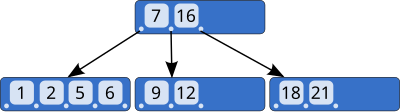
A B-Tree is a specialized m-way tree designed to optimize data access, especially on disk-based storage systems. In a B-Tree of order m, each node can have up to m children and m-1 keys, allowing it to efficiently manage large datasets.
In computer science, a B-tree is a self-balancing tree data structure that maintains sorted data and allows searches, sequential access, insertions, and deletions in logarithmic time.
They are general form of a Binary Search Tree as it holds more than one key and two children. The various properties of Btrees include −. Every node in a BTree will hold a maximum of m children and (m-1) keys, since the order of the tree is m. The root node must have no less than two children.
Like any other tree datastructure, three primary operations can be performed on a B-tree: searching, insertion, and deletion. Let’s discuss each operation one by one.
Learn BTreeinDataStructure, its properties, examples, implementation, and a full guide to understanding this data structure for efficient data storage.
What Is a B-TreeDataStructure? A B-tree is a self-balanced tree data structure that is a generalized form of the Binary Search Tree (BST). However, unlike a binary tree, each node can have more than two children.
B-Trees are self-balancing tree data structures that maintain sorted data and allow searches, sequential access, insertions, and deletions in logarithmic time. They are optimized for systems that read and write large blocks of data and are commonly used in databases and file systems.
However, the B-Tree, a special type of search tree, allows a node to contain more than one value (key) and more than two children, which allows for efficient searching, insertion and deletion of records. B-Tree can be defined as follows...
In order to achieve this, the following rules are followed to create a BTree. A B-Tree is a special kind of tree in a datastructure. In 1972, this method was first introduced by McCreight, and Bayer named it Height Balanced m-way Search Tree.
By 1979, B-trees had replaced virtually all large-file access methods other than hashing. B-trees, or some variant of B-trees, are the standard file organization for applications requiring insertion, deletion, and key range searches. They are used to implement most modern file systems.